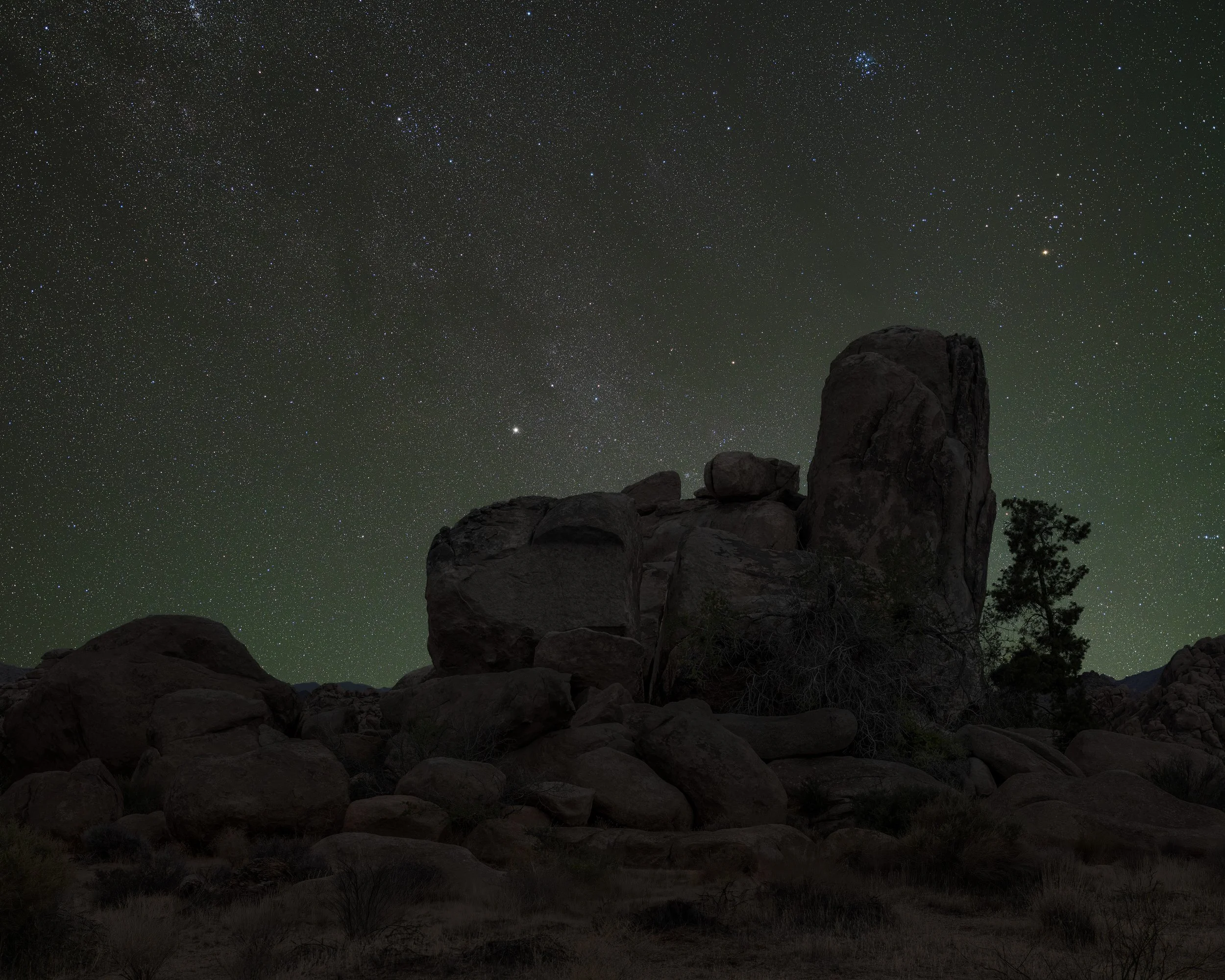
High Desert Test Sites is pleased to announce the opening of Way Station, a new photographic installation by An-My Lê, presented at A-Z West, as her 2025 HDTS Fellowship project.
The works will open Saturday, January 17th, 2026, from 12:00-4:00 PM
Way Station is situated within the Planar Pavilions, which are just north of A-Z West/HDTS at the intersection of Center Avenue and Old Dale Road.
The site is accessible to the public seven days a week from sunrise to sunset.
Born in Saigon, Vietnam in 1960, Lê fled the country with her family in 1975 at the age of 15, resettling in the United States as a political refugee. Now based in Brooklyn, New York, Lê has developed a pioneering photographic practice that interrogates the role of landscape as both witness and participant in history. Her work has explored the lingering effects of war on both the natural environment and cultural narratives, creating bodies of work that redirect focus from the deeply personal to a distant view of history and time, while still embedding the immediacy and experience of the emotional contradictions of violence and awe.
Way Station is informed by Lê’s sustained engagement with desert landscapes, beginning with 29 Palms (2003–2005), a photographic series produced at the Marine Corps Air-Ground Combat Center in Twentynine Palms, California, and extending to more recent encounters with sites central to the history of land art, including Michael Heizer’s Double Negative and City, and Walter De Maria’s The Lightning Field. These experiences intersect with Lê’s long-standing interest in the historical and conceptual entanglements between land art and the militarization of landscape. A recent meditation on the latter, including the austere gravity of seemingly benign terrain, was explored in the series Gray Wolf. Together, they have prompted a renewed inquiry into site specificity and the conditions under which it might be meaningfully engaged through photography.
For Lê, site specificity is an intrinsic condition of her photographic practice, grounded in physical presence, duration, and the act of bearing witness. Distinct from land art practices rooted in direct intervention, her photographs do not document a landscape she has altered. Instead, they engage terrain shaped by transformations that exceed immediate human perception: processes unfolding across archaeological, geological, cosmic, and military temporalities, as well as those accelerated by climate change and the limits of finite and renewable energy systems. For her, the desert, in this sense, is neither static nor neutral, but a site of accumulation, inscription, and endurance.
Lê’s relationship to the Californian high desert began in the early 2000s through repeated drives along the Twentynine Palms Highway, passing through the San Gorgonio Pass with its vast wind farms, military convoys, and infrastructural thresholds. Twenty years later, she returned to this landscape as an artist-in-residence at HDTS, where the site and surrounding terrain enabled Lê to extend her investigation into cosmic energy, celestial navigation, and stellar nuclear forces alongside the terrestrial production of clean, renewable energy generated by neighboring wind farms.
Anchored by HDTS founder Andrea Zittel’s Planar Pavilions, Way Station takes the form of an installation comprising photographs of night skies first explored in Dark Star in 2024 in Mesa Verde, CO, and recently made in and around Joshua Tree National Park, paired with daytime images of operational wind turbines in the San Gorgonio Pass. These images are interwoven with mirrored surfaces, positioning the high desert simultaneously as canvas and subject, while photography operates as both mirror and window. Drawing on photographer and curator John Szarkowski’s formulation of these dual impulses, the work occupies a space between outward exploration and inward reflection. The photographs function as windows that extend toward maps, terrains, and constellations drawn from the sky, while also acting as mirrors that reflect our efforts to interpret, measure, and inhabit celestial power.
Way Station opens on January 17, 2026 and will remain on view during open hours. The site is open to visitors from sunrise to sunset.
About the Artist:
An-My Lê was educated at Stanford University and at Yale University and has been the recipient of numerous awards including the MacArthur Foundation Fellowship (2012); the Louis Comfort Tiffany Foundation Award (2009); and the Guggenheim Memorial Foundation Fellowship (1997), amongst others. Lê is currently the Charles Franklin Kellogg and Grace E. Ramsey Kellogg Professor in the Arts at Bard College, New York.
In 2023, the Museum of Modern Art, New York, organized Between Two Rivers /Giữ a hai giòng sông/Entre deux rivières, a survey of Lê’s work, and in 2021 a major exhibition opened at the Carnegie Museum of Art, Pittsburgh, Pennsylvania, and travelled to the Milwaukee Art Museum, WI, and the Amon Carter Museum of Art, TX. Other solo exhibitions of Lê's work have been presented at the Sheldon Art Museum, Lincoln, Nebraska (2017); Hasselblad Foundation, Gothenburg, Sweden (2015); Baltimore Museum of Art, Maryland (2013); Dia: Beacon, New York (2008); San Francisco Museum of Modern Art, California (2008); and MoMA PS1, Long Island City, New York (2002).
Her work has also been included in the Whitney Biennial, Whitney Museum of American Art, New York (2017) and the Taipei Biennial (2014 and 2006). She has been included in numerous international group shows including at the Minneapolis Institute of Art, Minnesota (2019); Metropolitan Museum of Art, New York (2017); the Museum of Modern Art, New York (2016); National Museum of Art, Osaka, Japan (2015); Tate Modern, London (2014); Brooklyn Museum (2012); and the Guggenheim Museum, New York (2010) amongst others.
About HDTS Fellowship:
The HDTS Fellowship is an annual invitation that provides one established artist per year the opportunity to spend extended time at A-Z West while working to realize an artwork or program that engages and enriches our High Desert community.
The HDTS Fellowship Program is funded in part by generous support from The Horace W. Goldsmith Foundation and Wilhelm Family Foundation.